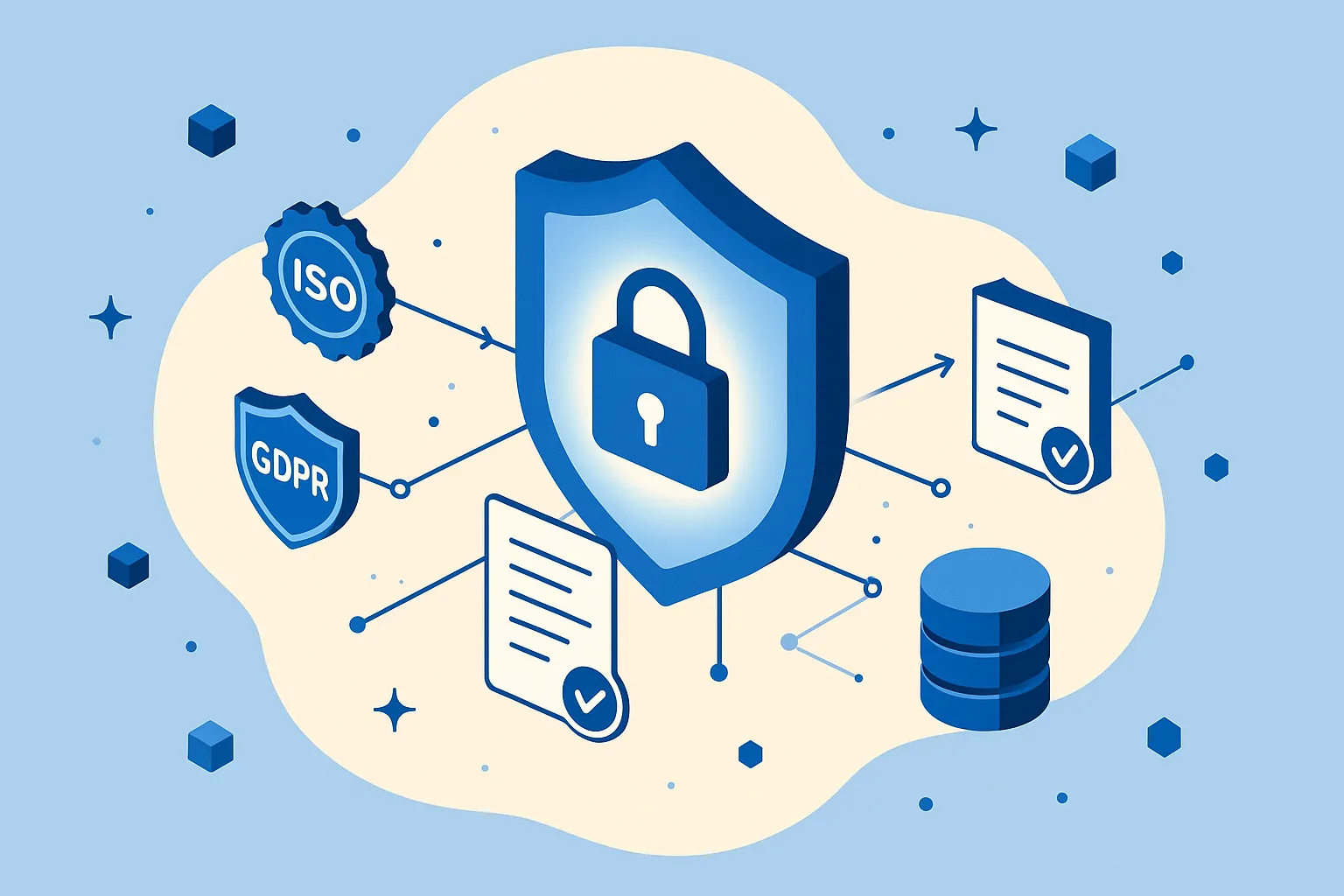
A trust center is a public-facing portal where a software vendor or service provider proactively shares security documentation, compliance certifications, and privacy policies with prospective buyers. Instead of waiting for each buyer to send a security questionnaire, a trust center puts the most commonly requested security information in one place where procurement, security, and legal teams can review it on demand.
Trust centers have become a standard part of enterprise sales infrastructure. They serve a specific purpose in the vendor assessment process: reducing the back-and-forth between sellers and buyers during security due diligence. But they solve only one half of the problem. They reduce the number of questionnaires your team receives. They do not eliminate them.
Why do enterprise vendors need a trust center?
Enterprise buyers evaluate vendors on security posture before signing contracts. That evaluation historically starts with a security questionnaire — a formal document with anywhere from 50 to 800+ questions about encryption, access controls, incident response, and compliance certifications.
The problem: answering the same questions repeatedly is expensive. A vendor selling to 50 enterprise accounts per quarter might receive 50 separate questionnaires asking nearly identical questions about SOC 2 compliance, data encryption, and sub-processor management.
A trust center short-circuits this cycle by answering common questions before they're asked. When a buyer's procurement team can access your SOC 2 report, review your sub-processor list, and download your DPA without sending a questionnaire, your security team spends less time on repetitive responses and your sales cycle moves faster.
There are three business outcomes a trust center delivers:
- Reduced questionnaire volume. Industry data suggests trust centers deflect 30-50% of inbound security questionnaires by satisfying buyer information needs proactively.
- Faster sales cycles. Buyers who can self-serve security documentation move through procurement faster than those waiting for questionnaire responses.
- Consistent security narrative. Every buyer sees the same approved documentation rather than ad-hoc answers assembled by different team members under deadline pressure.
What should a trust center include?
A comprehensive trust center covers what enterprise procurement, security, and legal teams actually request during vendor assessments. Here is what belongs in each category:
Compliance certifications and audit reports
- SOC 2 Type II report (or executive summary with NDA-gated full report)
- ISO 27001 certificate
- Additional certifications as applicable: HIPAA attestation, PCI DSS, FedRAMP, StateRAMP
- Penetration test executive summary (typically NDA-gated)
Privacy and data protection
- Privacy policy
- Data processing agreement (DPA)
- Sub-processor list with update history and notification mechanism
- Data residency and sovereignty information
- GDPR-specific documentation for EU buyers
Security architecture and controls
- Security whitepaper or architecture overview
- Encryption standards (at rest and in transit)
- Access control and authentication (SSO, MFA, RBAC)
- Business continuity and disaster recovery summary
- Incident response policy overview
Real-time status (optional but increasingly expected)
- System uptime and status page
- Continuous compliance monitoring status
- Recent security audit dates
Not every document needs to be publicly accessible. Sensitive materials like full SOC 2 reports and penetration test summaries are typically gated behind NDA acceptance or email verification.
How do trust centers reduce security questionnaire volume?
Trust centers reduce questionnaire volume through two mechanisms: deflection and simplification.
Deflection happens when a buyer's security team reviews the trust center and determines they have enough information to approve the vendor without sending a formal questionnaire. This is most common for standard assessments where the buyer's checklist maps directly to SOC 2 controls and the trust center provides clear evidence of compliance.
Simplification happens when a buyer still sends a questionnaire but scopes it down because the trust center already answered many of their questions. Instead of a 400-question SIG covering SOC 2, ISO 27001, and GDPR, the buyer sends a 50-question supplement focused on their custom requirements.
But trust centers have clear limits. Enterprise buyers in regulated industries — financial services, healthcare, government — often have mandatory assessment frameworks that require formal questionnaire submission regardless of what a trust center provides. Custom security frameworks, organization-specific risk tolerances, and procurement compliance rules all generate questionnaire volume that trust centers cannot deflect.
This is why trust centers and questionnaire automation are complementary, not interchangeable. The trust center reduces volume. Automation handles what remains.
Trust center vs. security questionnaire automation: what's the difference?
| Trust Center | Questionnaire Automation | |
|---|---|---|
| Direction | Proactive: vendor publishes, buyer consumes | Reactive: buyer sends questions, vendor responds |
| Primary function | Self-service security documentation portal | AI-generated responses to formal assessments |
| Reduces | Number of inbound questionnaires | Time to complete each questionnaire |
| Covers | Standard compliance questions with published answers | Custom questions, unique frameworks, DDQs, SIG, CAIQ, ad-hoc assessments |
| Limitation | Cannot handle custom or buyer-specific questions | Does not reduce inbound volume — only accelerates response |
| Example platforms | SafeBase, Vanta Trust Center, Whistic, Drata | Tribble, Responsive, Loopio, Conveyor |
The ideal security review workflow uses both layers. A trust center handles proactive disclosure and deflects routine inquiries. When buyers still send formal assessments — and they will — questionnaire automation generates cited, accurate responses from the same underlying knowledge source. Together, they eliminate the security assessment bottleneck from the sales cycle.
What are the best trust center platforms in 2026?
For a detailed comparison of trust center platforms including feature breakdowns, pricing models, and deployment considerations, see our full guide: Best AI Trust Center and Security Portal Platforms Compared (2026). Here is a summary of the leading options:
SafeBase
Purpose-built trust center platform. NDA-gated document sharing, questionnaire deflection analytics, and buyer engagement tracking. The most focused trust center solution — security documentation is the entire product.
Vanta Trust Center
Integrated with Vanta's compliance automation suite. Automatically publishes compliance status from Vanta's continuous monitoring. Strong choice for teams already using Vanta for SOC 2 or ISO 27001 compliance.
Conveyor
AI-powered trust center with automatic questionnaire response capabilities. Bridges the gap between trust center and questionnaire automation. Handles both proactive disclosure and reactive response within a single platform.
Whistic
Trust network model where vendors and buyers share security profiles. Focuses on the relationship between the two sides of vendor assessment rather than just document publishing.
Drata Trust Center
Compliance-first trust center powered by Drata's continuous monitoring engine. Real-time compliance dashboards and automated evidence collection. Best for teams that prioritize continuous compliance visibility.
HyperComply
Trust center combined with intake automation. Manages the entire inbound security assessment workflow from trust center deflection through questionnaire triage.
For teams that also handle security questionnaires, RFPs, and DDQs, Tribble provides the response automation layer. Tribble connects to your existing knowledge sources — SharePoint, Confluence, Google Drive, Notion — and generates cited answers with confidence scoring. The trust center deflects routine inquiries; Tribble handles everything else from a unified knowledge base.
How to build and launch a trust center: 5-step process
1. Audit your existing security documentation — Inventory every compliance certification, audit report, security policy, and data processing agreement your organization holds. Identify gaps where documentation is outdated, missing, or not yet formalized. Common gaps: penetration test summaries that haven't been updated in 18 months, DPAs that don't reflect current sub-processors, security whitepapers that predate major architecture changes.
2. Choose your trust center platform — Evaluate based on three criteria: your volume of inbound security requests (high volume justifies a dedicated platform), buyer expectations in your industry (financial services and healthcare buyers have specific trust center expectations), and your existing compliance tooling (if you already use Vanta or Drata for compliance, their integrated trust centers reduce setup effort).
3. Structure content by buyer persona — Different stakeholders need different documents. Procurement teams look for SOC 2 reports and DPAs first. Security teams want penetration test summaries and architecture diagrams. Legal teams prioritize privacy policies and sub-processor lists. Organize your trust center around these three workflows rather than dumping every document into a flat list.
4. Set up access controls and analytics — Gate sensitive documents (full SOC 2 reports, pen test results) behind NDA acceptance or email verification. Configure analytics to track which documents buyers access most, which pages have the highest drop-off rates, and which questions buyers ask after reviewing the trust center. These signals tell you what to improve.
5. Launch and connect to your questionnaire workflow — Add the trust center link to your website footer, sales decks, and initial outreach emails. Brief your sales team so they proactively share it during discovery calls. Most critically, connect the trust center to your questionnaire response workflow. When buyers still send formal assessments, your response tool should reference the same source documentation that powers the trust center — ensuring consistency between what you publish proactively and what you submit reactively.
Trust center statistics and trends for 2026
Adoption and impact
- Industry research indicates trust centers can deflect 30-50% of inbound security questionnaire volume for enterprise vendors.
- Vendors with trust centers report shorter sales cycles for deals that require security review — buyers who self-serve documentation close faster than those waiting for questionnaire responses.
- The average enterprise vendor receives 100-300 security questionnaires per year, each requiring 20-40 hours to complete manually.
Buyer expectations
- Enterprise procurement teams increasingly expect vendors to have a trust center as a baseline. Its absence signals immaturity in security operations.
- Buyers use trust centers for initial screening. They then send questionnaires to probe areas where the trust center was insufficient or where they need vendor-specific attestation.
- NDA-gated access to sensitive documents (SOC 2 reports, pen test summaries) is standard practice and expected by security-conscious buyers.
Technology trends
- AI-powered trust centers are emerging that not only publish documents but also answer buyer questions in natural language using the published documentation as source material.
- Continuous compliance dashboards are replacing static document uploads. Buyers want real-time evidence that controls are active, not just point-in-time audit reports.
- Trust center + questionnaire automation integration is becoming the standard enterprise architecture — the trust center layer for proactive disclosure, the automation layer for reactive response, both fed by the same knowledge base.
Frequently asked questions
A trust center is a public-facing portal where a software vendor or service provider proactively shares security documentation, compliance certifications, and privacy policies with prospective buyers. It typically includes SOC 2 reports, ISO 27001 certificates, penetration test summaries, data processing agreements, sub-processor lists, and security architecture overviews. The goal is to let buyers self-serve the security information they need during vendor evaluation, reducing the volume of formal security questionnaires vendors must respond to.
No. Trust centers reduce questionnaire volume — typically by 30-50% — but do not replace questionnaires entirely. Enterprise buyers with custom frameworks, regulated procurement processes, or specific compliance requirements still send formal assessments. The trust center handles the proactive disclosure layer; questionnaire automation handles the reactive response layer. Most enterprise vendors need both.
Trust center platforms range from included-at-no-extra-cost (for teams already using Vanta or Drata for compliance) to standalone pricing starting around $10,000-$30,000 per year for platforms like SafeBase or Whistic. The cost calculation should include the time savings from deflected questionnaires: if each avoided questionnaire saves 20-40 hours of security team time, the ROI becomes clear at even modest deflection rates.
The terms are often used interchangeably. "Trust center" has become the more common term in the SaaS and enterprise software space. "Security portal" is sometimes used more broadly to include internal security dashboards or buyer-side assessment portals. Functionally, if it's a vendor-published, buyer-facing portal for security documentation and compliance certifications, it's a trust center regardless of what the vendor calls it. See our trust center platform comparison for a detailed breakdown of both types.
The trust center publishes your security documentation proactively and deflects a portion of inbound questionnaires. When buyers still send formal assessments — security questionnaires, DDQs, SIG, CAIQ, or custom frameworks — the questionnaire automation layer generates draft responses from the same underlying knowledge base. Tribble, for example, connects to sources like SharePoint, Confluence, and Google Drive to generate cited answers with confidence scores. The trust center reduces volume; automation accelerates what remains. Together, they eliminate the security assessment bottleneck.

See how Tribble handles security questionnaires
your trust center can't deflect
One knowledge source. AI-generated responses with confidence scoring.
Book a Demo.
Subscribe to the Tribble blog
Get notified about new product features, customer updates, and more.